History, policy, economics
See the consequences before the next policy repeats them.
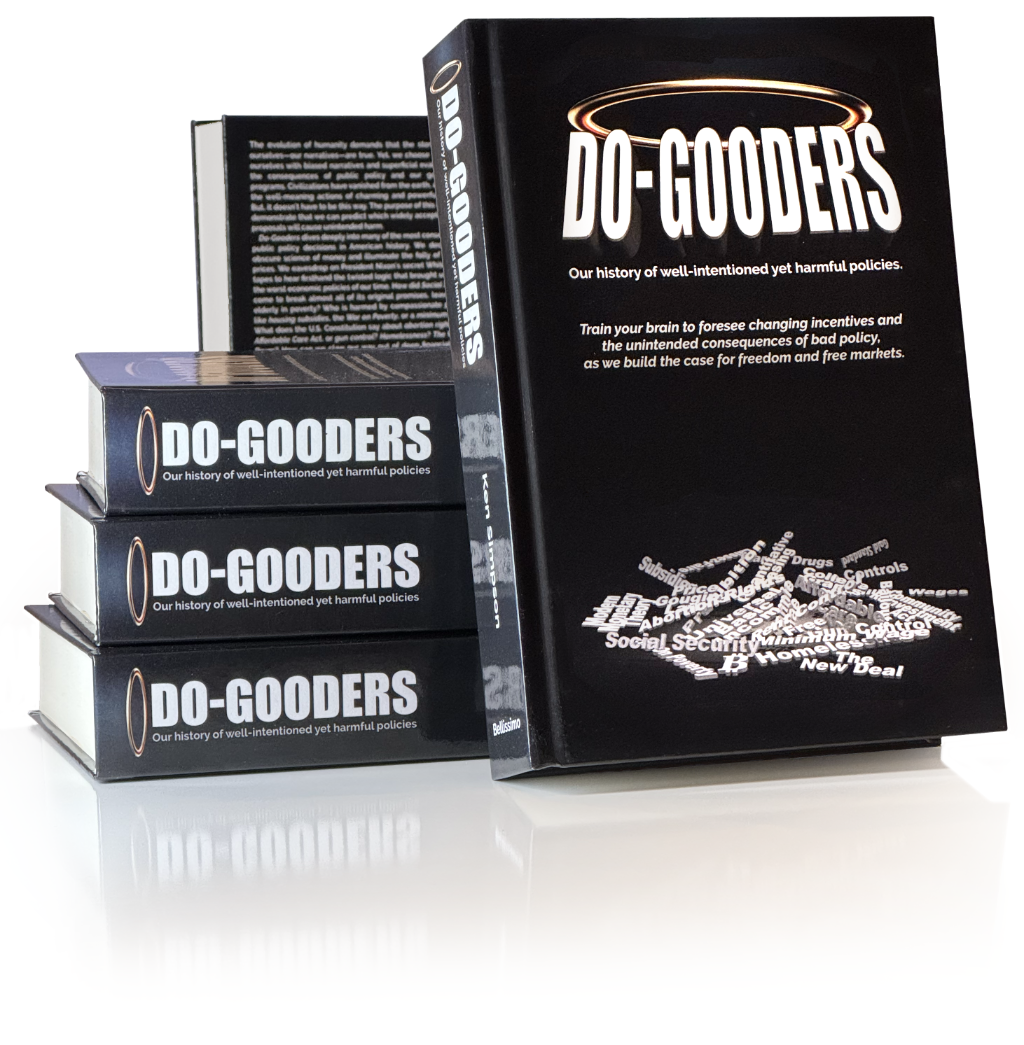
Do-Gooders is a deeply researched guide to incentives, tradeoffs, and unintended consequences in public policy, building the case for freedom and free markets.
What This Book Does
Do-Gooders offers a single-volume framework for understanding economics and public policy. It examines how well-meaning reforms can create harmful incentives, and cause long-term damage when second- and third-order effects are ignored.
The book is built for readers who want more than slogans. It is an argument for thinking more carefully about freedom, tradeoffs, and the proper role of government.
What You'll Learn
Inside, you will find detailed examinations of Social Security, housing subsidies, the War on Poverty, the minimum wage, price controls, the War on Drugs, Modern Monetary Theory, Universal Basic Income, Bitcoin, and major constitutional controversies tied to abortion, gun control, and the Affordable Care Act.
The book also traces the logic behind major policy failures, including Nixon-era economic controls and artificial prices, and studies how public narratives often hide the real incentive changes that drive unintended consequences.
Who It Is For
This is for readers who want a modern, rigorous examination of free-market economics and public policy in the tradition of serious thinkers such as Milton Friedman, Friedrich Hayek, Thomas Sowell, and Adam Smith.
It is also for readers trying to make sense of the differences between capitalism, socialism, communism, fascism, corporatism, anarchy, and laissez-faire economics without relying on superficial political talking points.
Why It Matters
Public debate has become tribal and shallow. Do-Gooders argues that many harmful policies are not created by malicious people, but by advocates who fail to think beyond first-order cause and effect. The medicine can be worse than the disease.
With more than 1,100 citations and footnotes, this book is thorough, and presents a coherent method for evaluating policy with an emphasis on liberty, minimal harm, and intellectual honesty. It is college-level material written to be readable by serious general readers.
This is not an afternoon read. It is the equivalent of several substantial books in one volume. But if you work through it, you will come away better equipped to judge public policy proposals on substance rather than rhetoric.
Now available in audiobook format
The Do-Gooders audiobook experience is built for active learning, not passive listening. The companion app lets listeners follow the text, view charts while the audio plays, share excerpts, and query using AI.
New listeners can start with the first 3 chapters free, along with 3 included audiobooks from Frédéric Bastiat.


AI Chat About the Book
This chat knows the entire book — 34 chapters, 2,100+ paragraph distillations with source text, 7,100+ index evidence notes, 133 enriched figures, axioms, and full index. Ask about any topic, argument, or example.
Chat about DO-GOODERS
This chat knows the entire book — 34 chapters, 2,100+ paragraph distillations with source text, 7,100+ index evidence notes, 133 enriched figures, axioms, and full index. Ask about any topic, argument, or example.
Bonus Materials
Bibliography
The source list behind the book's research and citations.
The Origins of the ACLU
Appendix A from the paperback, expanding on one of the book's historical threads.
Charts PDF
A printable reference set of the visuals used throughout the book.
Order the Book
Hardcover and paperback editions contain the same content. The paperback uses slightly larger type and wider margins for a more comfortable reading layout. Because Amazon restricts hardcover books to 550 pages, the hardcover has moved the Bibliography and Appendix here, to the web.
Buy on Amazon